Right to Disconnect Laws by Country: What Remote Teams Need to Know
Sending a Slack message at 7pm feels harmless. But if the person reading it is in France, Portugal, Belgium or Australia, there are rules about how work can reach people outside their hours, and in Germany a late request can eat into a legally protected rest period.
Here’s where right to disconnect rules apply, what they actually require, and what they mean for a team spread across several countries.
What the right to disconnect means
A right to disconnect lets employees ignore work calls, messages and emails outside their working hours without being penalised for it. Most of these laws don’t ban the message itself. They make it the employer’s job to set clear rules about contact outside hours, and they protect people who choose not to reply.
Underneath them sits an older rule that applies across the EU and the UK: workers are entitled to at least 11 consecutive hours of rest in every 24. Disconnect laws are largely about stopping laptops and phones from quietly wearing that rest away.
Germany: no disconnect law, but strict working time rules
Germany is the country people most often assume has banned work email in the evening. It hasn’t. There’s no specific right to disconnect law, and the best known examples, like Volkswagen stopping work email from reaching some employees’ phones after their shift, are company policies rather than legislation.
What Germany does have is the Working Time Act (Arbeitszeitgesetz), and it’s stricter than many managers expect:
- A working day is normally limited to eight hours. It can stretch to ten, but only if the average comes back down to eight over six months.
- After the working day ends, employees must get at least 11 hours of uninterrupted rest. Someone who finishes at 10pm shouldn’t start again before 9am.
- Sundays and public holidays are protected rest days for most employees.
- Since a 2022 Federal Labour Court ruling, employers have to record working time.
- Breaches can be fined up to €15,000.
This is where messages outside working hours start to matter. A German court has found that simply reading a short message doesn’t necessarily count as work. Picking up a request and spending half an hour on it does, and most German employment lawyers read the rule to mean that real work during the rest period interrupts it, so the 11 hours start again. Your 10pm question could mean your colleague in Berlin can’t legally start at their usual time the next morning.
Country by country
The rules vary a lot in strength. Here’s where things stand in late 2026.
France
France went first, in 2017. Companies with 50 or more employees have to agree how the right to disconnect works with employee representatives, or publish a charter that sets out the rules. Smaller companies still have to respect the right.
Portugal
Since late 2021, Portuguese employers have had a duty to avoid contacting employees during their rest periods, except in cases of force majeure. It’s one of the few laws aimed at the contact itself, and breaking it can lead to a fine.
Belgium
Federal civil servants have had a right to disconnect since 2022. Since April 2023, private employers with 20 or more employees have also had to set rules on being unreachable outside working hours, in a collective agreement or their work rules, and to train staff and managers on them.
Spain
Spain has recognised a right to digital disconnection since 2018. Employers need an internal policy on it, drawn up after consulting employee representatives, and it covers people working from home as well as in the office.
Italy
Since 2017, agreements for smart working, Italy’s term for flexible remote work, have had to set out rest periods and the measures that let employees disconnect from their devices.
Greece
A 2021 law gives teleworkers the right to switch off completely outside working hours and during leave, and protects them from being treated differently for doing so. It applies to remote workers rather than every employee.
Ireland
Ireland introduced a Code of Practice on the right to disconnect in 2021. It isn’t legally binding on its own, but it can be used as evidence if an employee brings a claim, so employers are expected to follow it.
Australia
Since August 2024, employees can refuse to monitor or respond to work contact outside their hours unless refusing is unreasonable. Small businesses with fewer than 15 employees were brought in from August 2025. Employers can still get in touch. What they can’t do is penalise someone for not answering.
Canada (Ontario)
Ontario employers with 25 or more employees must have a written policy on disconnecting from work and share it with staff. The policy doesn’t create a right to disconnect by itself, but it has to exist.
United Kingdom
The UK doesn’t have a right to disconnect. A “right to switch off” was planned, then dropped from the Employment Rights Bill in 2025. UK workers are still entitled to 11 hours of daily rest under the Working Time Regulations.
What this means for a distributed team
The realistic risk isn’t a fine for one late Slack message. It’s a pattern: someone who regularly sends requests at the end of their own day, which lands in the middle of somebody else’s evening. That pattern sits in your message history, and it matters if someone raises a grievance or burns out.
A few habits go a long way.
Know where everyone is and which rules apply. This changes as you hire, and as people move.
Agree what a late message means. Make it explicit that anything sent outside someone’s hours can wait until their next working day, unless it’s a genuine emergency.
Schedule rather than send. Slack, Microsoft Teams and Outlook can all schedule messages, so you can write when it suits you and deliver when it suits them.
Make working hours visible. It’s much easier to wait when you can see that a colleague in Lisbon finished at 6pm and it’s now 6:30pm there.
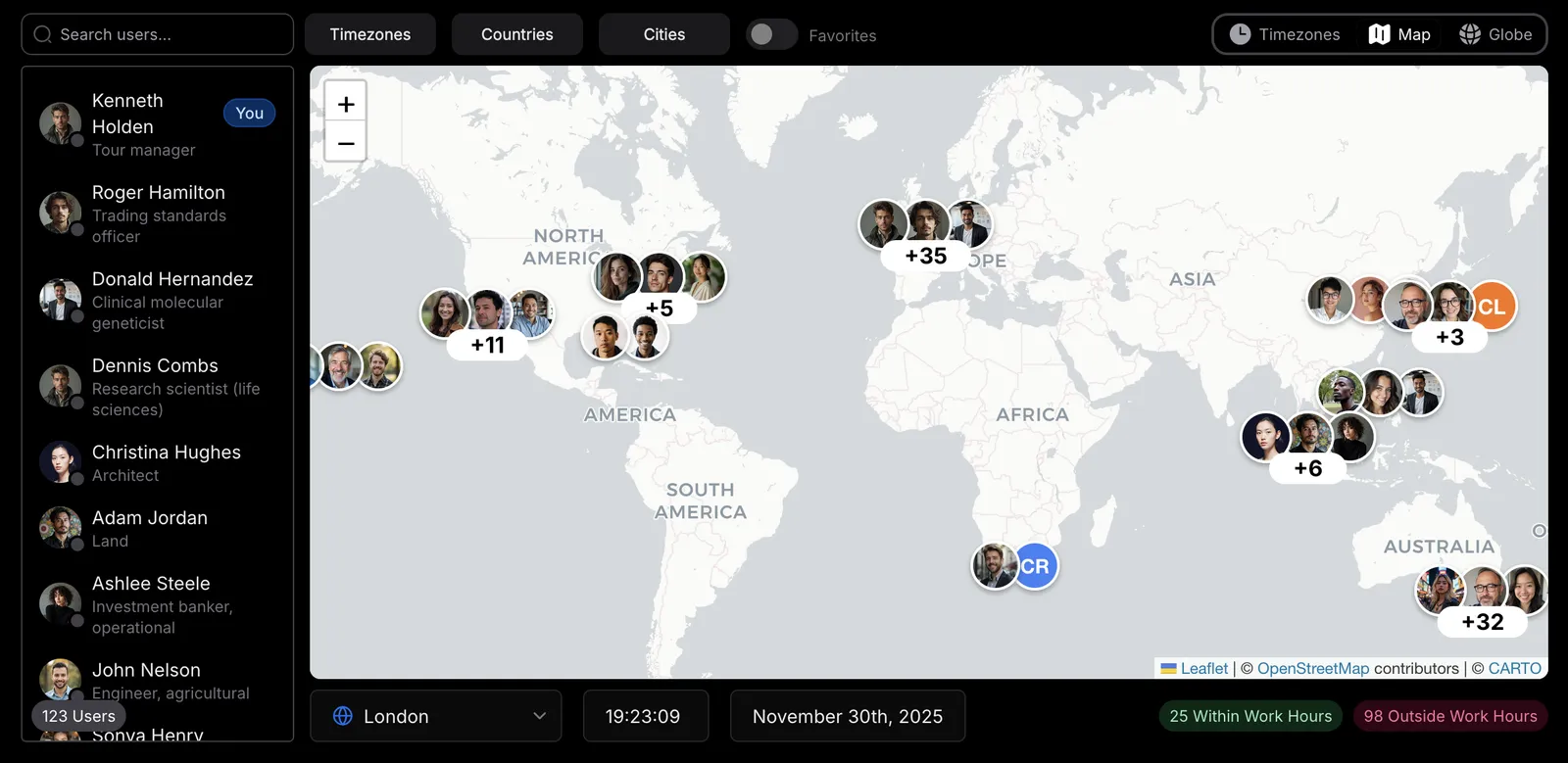
That last habit is the one TeamVis helps with. It shows each person’s local time and working hours on a team map and in a Mac menu bar app, along with national holidays and upcoming clock changes. In Slack or Microsoft Teams, the /workinghours command tells you when someone’s day starts and ends in your own time before you message them.
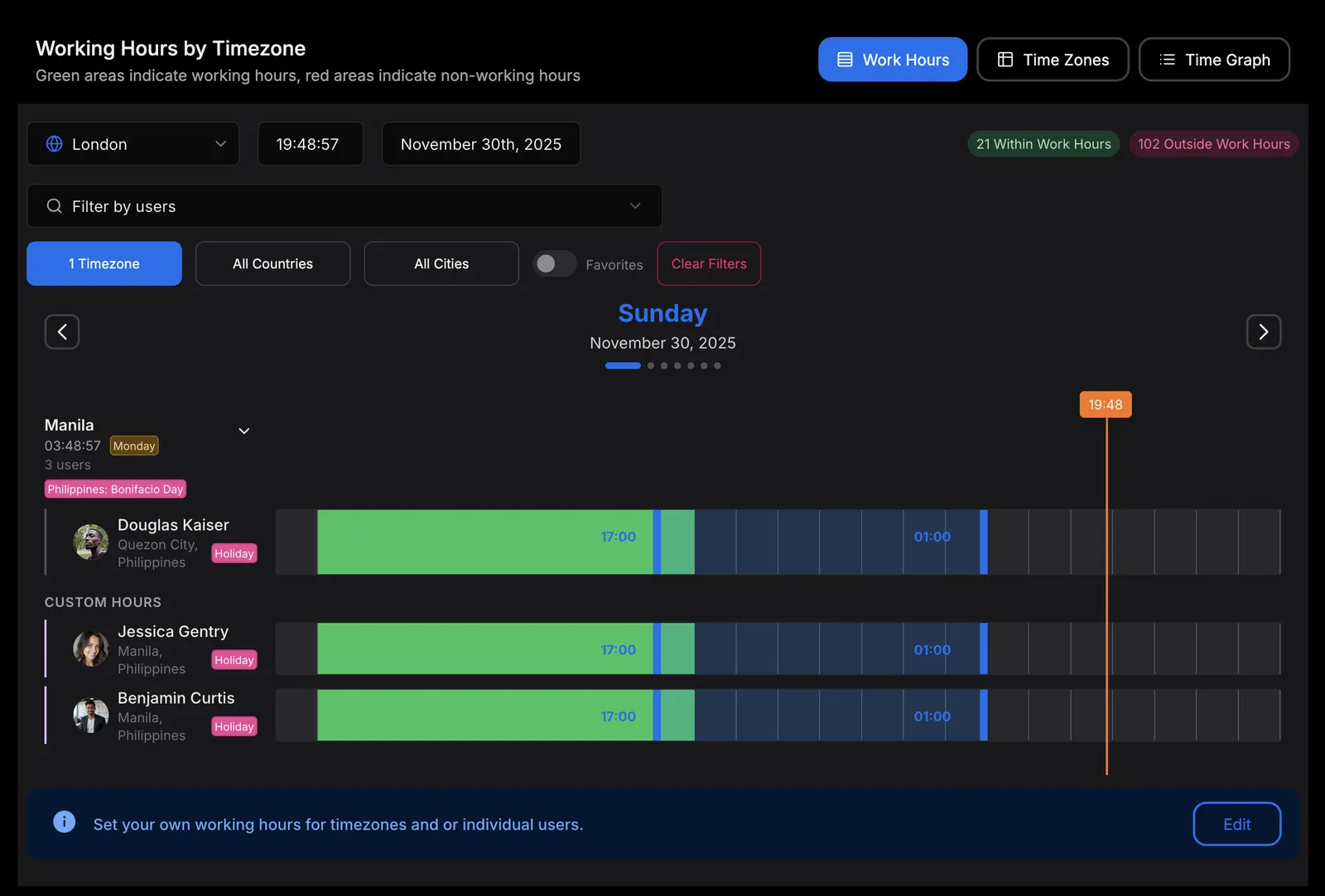
Each person’s working day on one timeline, with public holidays marked.
None of this makes you compliant on its own. That comes down to your policies and contracts. But it removes the guesswork behind most messages sent outside someone’s hours.
If your team works across more than a couple of countries, take a look at the live demo. No account needed.
This article is a general overview, not legal advice. Laws change, so check the current rules or speak to an employment lawyer in the relevant country before relying on them.